CabinFever
In developmentA dependency-free browser library that produces 17 traditional paper-marbling patterns with area-preserving geometric maps.
At a glance
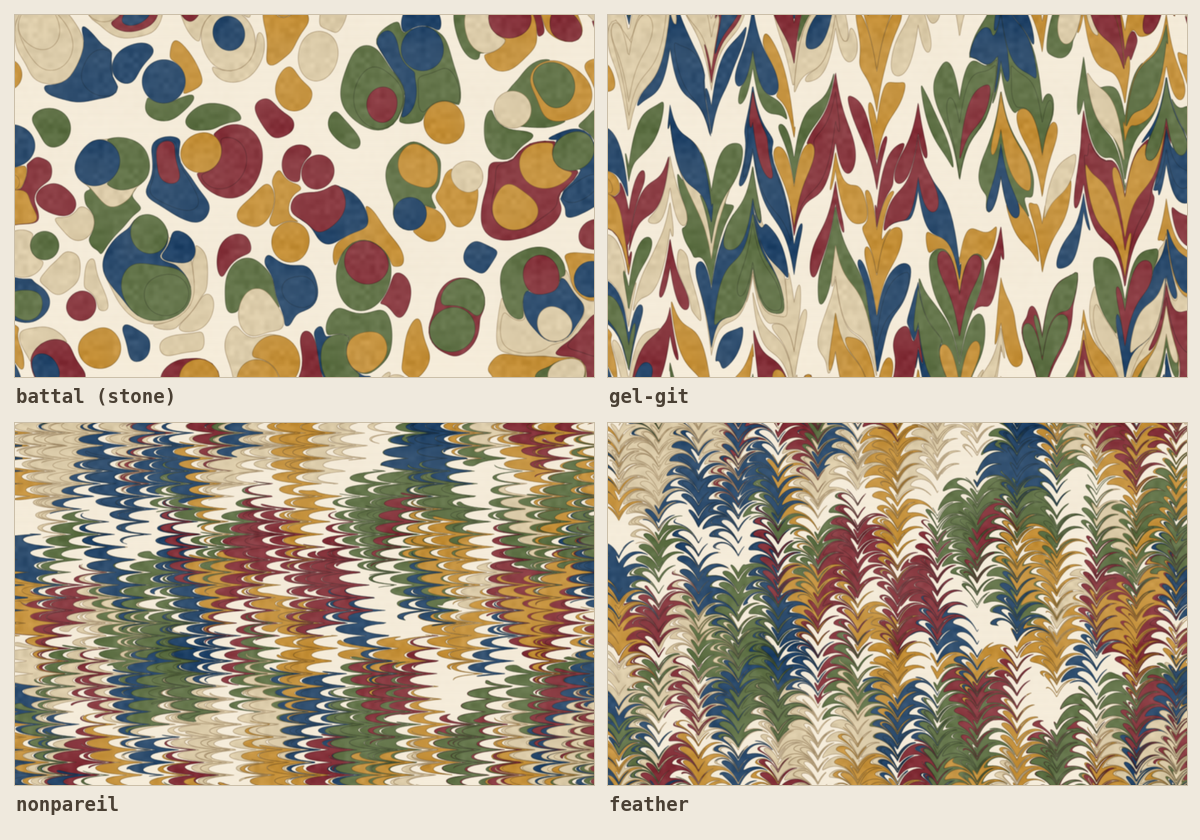
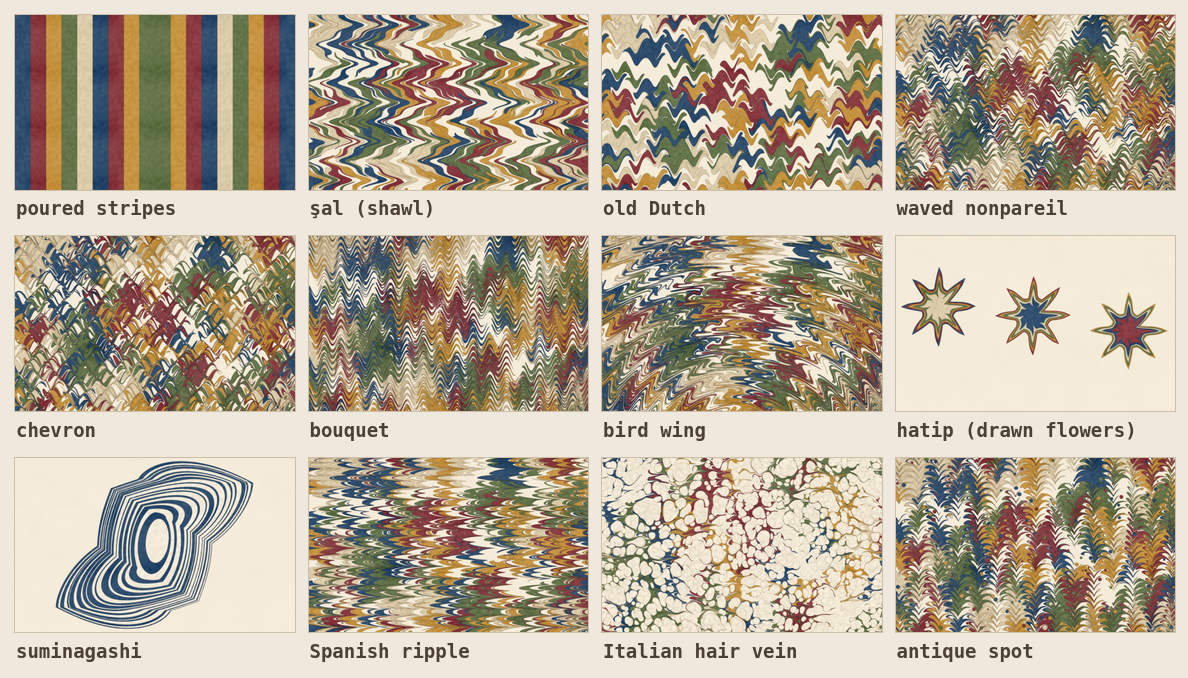
- Outcome: Implements 17 traditional pattern functions, including battal, gel-git, nonpareil, feather, şal, hatip, suminagashi, Italian hair vein and nine more. Treats every tool as an area-preserving plane map.
- Status: Second engine, at version 0.1.0; the first engine and 12
prototypes before it were discarded. On September 11, 2026, 162 commits end at the August 27 rebuild. The
demo vendors
94bcc65, two commits behind, using unchangedstone,gelGitandnonpareilto draw the same sheet. It predates the rake catalogue and 12 later patterns. - Role: Solo.
- Stack & libraries: Uses plain ESM, zero dependencies, no build step and one canvas.
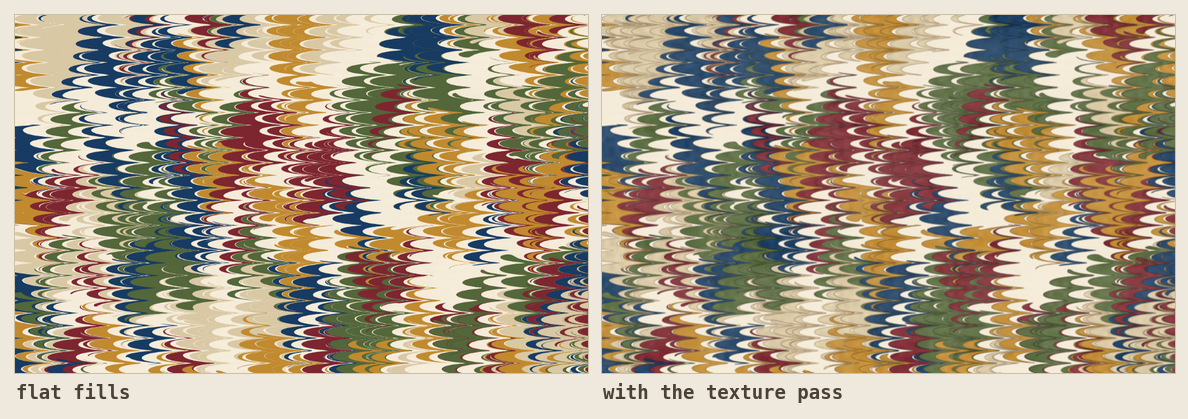
Runs a fragment-shader-style texture pass over CPU
ImageData, without WebGL and with headless support. Tooling uses Node, headless Firefox and WebDriver BiDi. - Source: Publishes the MIT-licensed source at github.com/Griffinhale/cabinFever.
- Validation: Runs 41 one-file
node --testcases in 0.4 seconds under Node 22 on September 11, 2026. Tests every map’s area preservation, every catalogue rake’s decay bound andr₁+r₂=√(r₁²+r₂²)composition to 1e-6. Every figure is generated from a seed with explicit timesteps and no clock. - Limitations: Provides no fluid solver, velocity field, timestepped physics or
colour mixing because pigment displaces rather than blends. Spanish ripple
shears film instead of lifting paper; its banding matches but its mechanism does
not. Finite lines walk their path placing discs above a spacing floor because no
closed-form map exists. Only the stylus lacks exact area preservation.
italianVeintakes about 2.4 seconds against feather’s 380ms for a reason that isn’t going away. The unpublished package makesnpm install cabinfeverfail, so this site vendors it.
Displacement model
Models ox-gall pigment on thickened size. New drops spread through noncompressible film and displace earlier colour into rings.
Maps every boundary. A radius r disc at C sends points to
C + (P−C)·√(1 + r²/‖P−C‖²). Because ρ′ = √(ρ² + r²) and
ρ′dρ′ = ρdρ, area is exact. Comb teeth create Jacobian-1 shears by moving
points parallel to their lines according to perpendicular distance.
Preserves exact polygon edges through any stretching, including hair-width filaments. Quadrature makes a held press equal one large drop, enabling exact frame-by-frame growth.
Prototype results
Compared 12 standalone pigment sketches across two waves with a pre-code rubric covering beauty, feel, collisions and later displacement support. All 12 stopped regions at neighbors because the rubric never tested displacement itself.
Built and discarded a grid engine from two prototypes. The repository retains both rounds and an identical-input contact sheet of all 12.
Pattern operations
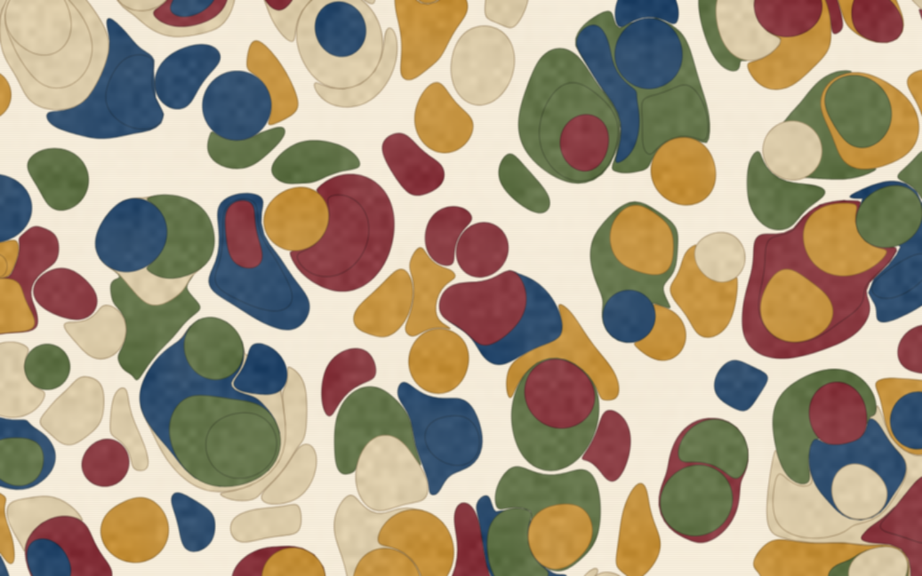
Adds one tool pass per traditional pattern. stone uses drops; gelGit uses an
across-tray down-and-up needle; nonpareil uses a fine straight comb; feather
adds a wide perpendicular comb.
Builds hatip from nested drops and an outward pull that forms petals. Equal drops
thin its rings as √k, matching a rosette’s fine outer bands. Suminagashi nudges
and shears two dozen alternating rings into contours rather than pushing. Italian
hair vein repeats the final colour’s drops to represent extra gall without modelling
it.
Comb spacing
Keeps comb decay well below tooth spacing. Similar values merge teeth into lane-free translation; full-spacing wave amplitude enters neighboring lanes, gives their teeth conflicting directions and creates cross-hatching.
Defines classic teeth as λ^(|s|/z). Its corner flips the derivative at s = 0,
leaving creases and opposing cusps. The rounded λ^((s/z)²) removes that corner
without moving the tooth while retaining both controls and one-decay-length
displacement. Both are exact
area-preserving shears based only on perpendicular distance.
Prior art
Uses Lu, Jaffer, Jin, Gao and Mao’s Mathematical Marbling (IEEE CG&A, 2012) and Aubrey Jaffer’s notes. The repository cites both, a contrasting fluid solver and the Turkish Cultural Foundation’s monograph. Original work includes the engine, gestures, rake catalogue, rounded tooth, texture pass and development account.
What it makes